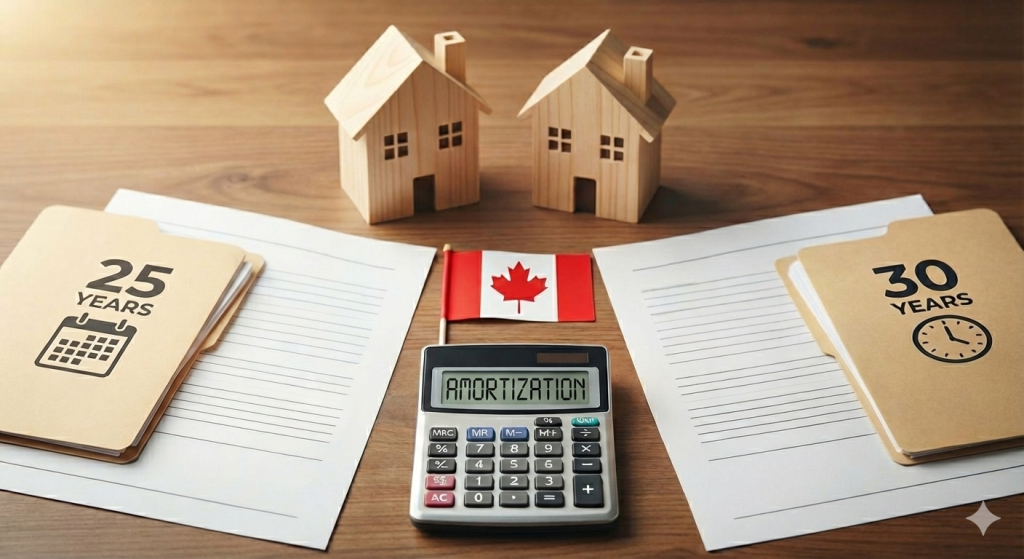
Choosing between a short or long mortgage amortization period can reshape your budget, interest costs, and flexibility. This guide explains how mortgage amortization works and how to choose the term that fits your goals.
Understanding mortgage amortization in Canada
Mortgage amortization is the total time it takes to fully repay your mortgage through regular payments. In Canada, common schedules span 15 to 30 years, with some uninsured mortgages extending to 35 years or even 40 years through select lenders. Each payment covers interest and a portion of your principal, gradually shrinking your balance.
The amortization period is different from your mortgage term, which is the length of your current contract—typically one to five years. When your term ends, you’ll renew your mortgage until the amortization period ends and the loan is fully paid off.
Amortization shapes your monthly payment size, your total interest paid, and how quickly you build equity. Shorter schedules front-load savings and long-term security, while longer schedules improve your monthly cash flow when budgets are tight.
Think of amortization as your mortgage’s payment speed on the road: shorter amortization is like when you want to save time (interest) so you should run faster and pay more for gas (cashflow), longer amortization is like when you want to moderate the cash flow (gas), so you need to run slower and spend more time (interest) to get to destination, which is your mortgage payoff date.
Short vs. long amortization: key differences
Shorter amortizations—such as 15 or 20 years—raise your monthly payment but cut interest dramatically. You own your home outright sooner, build equity faster, and have more options down the road for refinancing or selling with a larger equity cushion.
Longer amortizations—such as 30 or 35 years—lower your monthly payment, which can be valuable if you’re managing childcare, transportation, or business expenses. The trade-off is higher lifetime interest, and equity builds more slowly in the early years.
Your best choice depends on your cash flow, the stability of your income, and how quickly you want to reach other goals like saving for renovations, investing, or paying down higher-interest debt.
Higher payment now, less interest later. Lower payment now, more interest later. Your priorities decide the balance.
Current amortization trends in Canada
With higher interest rates in recent years, more Canadians have leaned toward longer amortizations to keep payments manageable. This choice helps protect monthly budgets, especially for families, newcomers to Canada, and self-employed borrowers with variable income.
At the same time, many homeowners still target 25 years because it aligns with traditional financial plans and encourages disciplined equity building. If your income is steady and you value long-term savings, a shorter schedule can be a powerful path to financial freedom.
Ultimately, a customized approach works best. Review your cash flow, your future plans, and your comfort with risk, then align the amortization to your needs—not the other way around. Explore more practical mortgage insights on the ProFinancing blog.
Regulatory limits and recent rule changes
For insured mortgages (down payment less than 20%), the maximum amortization is generally 25 years. For uninsured mortgages (20% or more down), many lenders allow up to 30 years, and some alternative or private lenders may offer up to 35 to 40 years depending on the file.
As of August 1, 2024, insured 30-year amortization is available to first-time home buyers or other people purchasing newly built homes. This targeted change aims to support affordability while encouraging new housing supply. See the Department of Finance announcement on 30-year insured amortizations for new builds for details and eligibility.
Canada’s mortgage stress test also affects how much you can borrow. Federally regulated lenders like Banks must qualify borrowers at the greater of 5.25% or their contract rate plus 2%, known as the Minimum Qualifying Rate (MQR). For the current standard and updates, refer to OSFI’s Mortgage Qualifying Rate. A longer mortgage amortization spreads your loan over more years, which lowers your monthly payment. Since the mortgage stress test looks at how much you can afford to pay each month, a lower payment, which the result from a longer amortization, can make it easier to qualify for a mortgage.
Keep in mind, policy settings can change. If you’re shopping for a mortgage or planning a renewal, confirm the latest eligibility rules and lender guidelines before deciding on your amortization.
If you’re unsure whether a recent rule applies to your scenario, ask your broker to review your down payment, property type, and occupancy to confirm which amortization options you can access today.
Pros and cons of short vs. long amortization
Choosing a shorter amortization can help you pay less interest over time and achieve full ownership sooner. Many homeowners appreciate the peace of mind that comes with faster equity growth, especially if they plan to refinance for renovations or invest in a second property later.
However, higher monthly payments may strain your budget, and that pressure can be stressful if your income is variable or you have large monthly expenses. If cash flow is your top priority, extending the amortization can provide breathing room without delaying your homeownership plans.
Longer amortizations are helpful for self-employed borrowers, households with childcare costs, or newcomers building credit. The trade-off is slower equity growth and more interest paid overall, which can reduce future flexibility if you need to refinance at lower equity levels.
A balanced strategy is to start longer for stability and shorten later when income rises. That way, you can protect your monthly budget today and still reduce total interest over time as your finances improve.
How to choose the right amortization period
Start with your budget and your comfort with monthly payments. If an unexpected expense would feel stressful, a longer amortization may be the right starting point. If your income is steady and you want to crush interest costs quickly, a shorter schedule could be worth the higher payment.
Next, think about your plans over the next five to seven years. If you expect rising income, you can begin with a longer amortization and accelerate later. If you anticipate maternity or parental leave, business changes, or new expenses, building in flexibility now can help you stay on track.
- Estimate your monthly comfort zone, including savings, childcare, and transportation.
- Check your qualifying rate under the stress test and confirm your maximum budget.
- Compare 20-, 25-, and 30-year scenarios to see payment and interest differences.
- Decide if you want flexibility today or faster equity tomorrow—then match the amortization.
Tip: If rates fall later, you can keep your payment the same and reduce your amortization faster through a fixed-payment variable-interest mortgage. A broker can show you how prepayment privileges and accelerated schedules impact your payoff timeline.
Flexibility: changing your amortization period
You can adjust your amortization when you renew, refinance, or switch lenders. Shortening your schedule raises the payment but cuts total interest. Extending your schedule lowers the payment but increases interest over the life of the loan. Always review any prepayment penalties and lender conditions before making changes.
Consider this simplified example: On a $500,000 mortgage at 3.95%, a 25-year amortization is roughly $2,625 per month, while a 30-year amortization is about $2,370 per month. That saves around $255 monthly today, but adds roughly $66,500 in interest over the full life of the mortgage. Your choice depends on whether monthly flexibility or long-term savings matters more right now.
You don’t always need a formal change to reduce your amortization. Using lump-sum prepayments, choosing accelerated bi-weekly payments, or rounding up each payment can trim months or even years off your schedule without refinancing.
When in doubt, map out both scenarios and stress-test your budget. A small change—like $50 to $100 extra per payment—can meaningfully shorten your timeline without feeling overwhelming.
Small, consistent prepayments can quietly save you thousands in interest and months off your amortization.
Conclusion
Mortgage amortization—whether short or long—directly affects your cash flow, stress level, and total interest. If you need payment breathing room, a longer schedule can help. If you want to payoff your mortgage faster and save interest, aim shorter and use prepayments to accelerate when you can.
Every household is different. The right choice aligns with your income, your goals, and your timeline. A broker can model scenarios side by side and help you move forward with confidence.
Ready to see how ProFinancing can help with the right amortization strategy for your mortgage?
Contact us for consultation.
Frequently asked questions
- Can I get a 30-year amortization in Canada?
- Uninsured mortgages commonly allow up to 30 years, and some alternative lenders may offer up to 35-40 years. For insured mortgages, 30 years is available only to first-time buyers or who purchase newly built homes as of August 1, 2024. Otherwise, insured mortgages are generally capped at 25 years.
- Can I change my amortization at renewal or when switching lenders?
- Yes. You can usually shorten or extend your amortization at renewal, refinance, or when switching lenders, subject to qualification and lender guidelines. Confirm prepayment penalties, stress test requirements, and any product-specific rules before committing.
- Is it better to choose a longer amortization and pay extra?
- For many homeowners, yes—starting longer can protect cash flow, and voluntary prepayments can lower interest without locking you into a higher mandatory monthly payment. Just ensure your mortgage includes prepayment privileges and track your progress annually.